
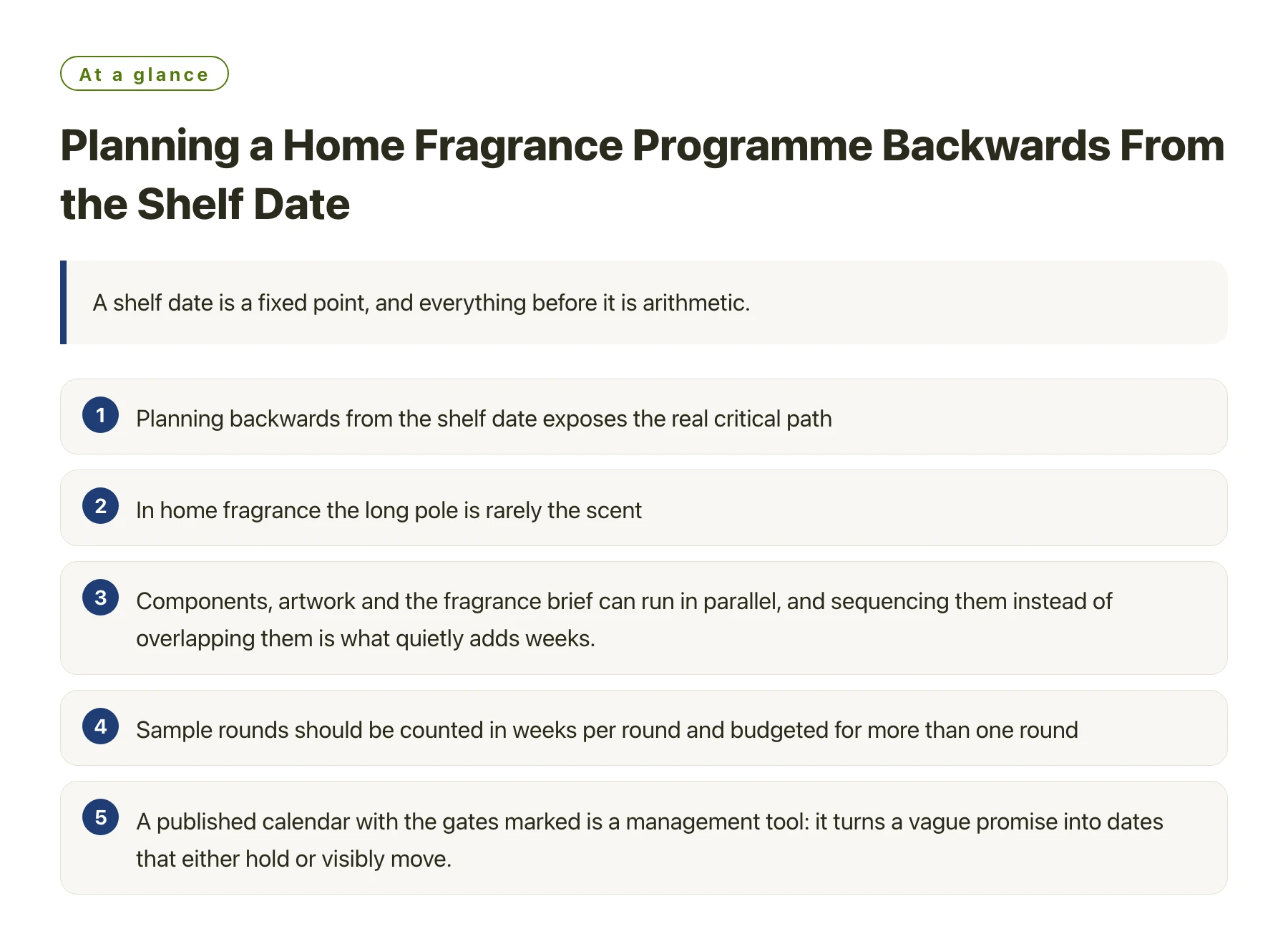
A shelf date is a fixed point, and everything before it is arithmetic. Working backwards from the date the product must be on shelf — rather than forwards from the day a supplier is briefed — is the only reliable way to see which step is actually going to slip. In home fragrance the long pole is rarely the scent. It is the custom vessel, the cure time and the stability window, usually in that order.
Key takeaways
- Planning backwards from the shelf date exposes the real critical path, which in home fragrance is normally the custom vessel rather than the fragrance.
- In home fragrance the long pole is rarely the scent; it is the custom vessel, the cure time and the stability window, in that order.
- Components, artwork and the fragrance brief can run in parallel, and sequencing them instead of overlapping them is what quietly adds weeks.
- Sample rounds should be counted in weeks per round and budgeted for more than one round, because a single-round approval is the exception.
- A published calendar with the gates marked is a management tool: it turns a vague promise into dates that either hold or visibly move.
Most first projects are planned forwards. The brief goes out, the sample arrives, the order is placed, and somewhere near the end a retail date appears and becomes a problem. The same project planned backwards looks different: the retail date is the first line on the page, and every step is judged by whether it fits before the line above it.
This is also the fastest way to test a supplier's answer to the lead time question. A supplier that can count back with you has a process; one that answers with a single number is guessing on your behalf.
Counting back from the shelf date
- Shelf date and listing deadlineStart with the day the product must be sellable, and subtract whatever administrative window the retailer requires before that.
- Distribution and inboundFreight, customs clearance and warehouse intake sit between the finished pallet and the shelf; seasonal peaks lengthen this step, not shorten it.
- Packing, cure and final quality checksCandles need a cure interval before they perform predictably, and every format needs a final check before cartons are sealed.
- Bulk production and fillingThe production run itself, plus the first-article check on decoration or assembly if either happens at volume.
- Stability and compatibility testingTesting runs on the finished format — the wax, the carrier or the reed system — and it is a calendar item, not a formality.
- Sample approval roundsEach round costs shipping plus evaluation time, and most projects need more than one; budget for two and be pleased with one.
- Brief, quotation and scope agreementOne written brief, one itemised quote, and a scope that names who does development, filling and decoration.
- Component sourcing and artworkThis is the step that usually starts first and finishes last when the vessel is custom or the decoration is complex.
What each workstream blocks, and how it is usually mis-sequenced
| Workstream | What it blocks | Common sequencing mistake |
|---|---|---|
| Custom vessel and closure | Decoration, filling and the finished carton | Starting the vessel after the scent is approved instead of alongside it |
| Artwork and print | Carton and label ordering | Treating label text as a design task rather than a decision with a deadline |
| Fragrance brief and dosage | Sampling, then compatibility testing | Briefing one format when the line will actually carry three |
| Stability and compatibility | Freezing the formula and ordering components | Running it after bulk production instead of before the freeze |
| Cure and rest interval | Packing and shipping | Assuming a candle ships the day it is poured |
| Freight and customs | The shelf date itself | Booking standard transit into a seasonal peak and expecting it to hold |
Read this as a dependency map rather than a schedule. Where two rows do not depend on each other, they can run at the same time, and overlapping them is how a compressed calendar becomes possible at all.
Why the fragrance is usually not the bottleneck
A brief written clearly enough to be acted on can produce a usable direction quickly, and a library scent can be selected even faster. The slow part is not creating a smell; it is proving that the smell behaves in the format you intend to sell, at the fill weight you intend to declare, in the packaging you intend to ship. That is testing and production work, and it has its own duration.
A useful check on that assumption is what a supplier chooses to publish about its own process on its official website. A manufacturer that lists the steps it performs itself is describing a schedule it already understands, and that description can be compared line by line with the dates in your reverse calendar.
Packaging decisions deserve the same treatment. Guidance from packaging sustainability work consistently lands on the same point: material and format choices belong at the beginning of a project, because changing them later invalidates artwork, tooling and testing together [1]. A vessel swap in week ten does not cost the difference between two glasses; it costs the difference between two schedules.
Trade coverage of the household products industry reports the same bottleneck from the supplier side, where filling and packing capacity tightens around seasonal peaks [2]. A buyer who plans a launch into that window without knowing it will read the delay as a supplier failure, when it was a calendar error made months earlier.
Making the calendar a document both sides own
A reverse calendar is only useful if it has named gates: brief approved, sample approved with a retained reference, formula frozen, components received, first article signed off, goods released. Each gate should have a date and a person. Then the weekly review is not a status update but a comparison between two documents.
For a brand ordering its own label for the first time, the sequence above is worth comparing with a manufacturer that publishes what it holds under a factory for your own perfume label. The point of reading it is not to adopt someone else's dates; it is to find out which questions the supplier already expects to answer.
It is also worth seeing how capacity and scheduling are described where suppliers discuss production capacity and lead times. Home fragrance production is capacity-constrained at particular times of year, and a supplier that publishes its own view of that constraint is easier to plan around than one that only answers when asked.
If you want one habit to keep from all of this, keep the buffer visible. Put the buffer in the plan as a line item with a number of weeks attached, and let the project consume it openly. A hidden buffer gets spent twice, once by the delay and once by the argument about whose delay it was.
One question separates a supplier with a process from one without it: ask them to count back from your shelf date and tell you where the float is. If there is no float anywhere in the answer, the plan is a hope with dates attached.
Sources
- Sustainable Packaging Coalition —— A membership organisation working on more sustainable packaging design, publishing material and recyclability guidance.
- HAPPI — Household & Personal Products Industry —— An industry magazine covering the household and personal care market, including fragrance, formulation and packaging.
Frequently asked questions
How long does a private label home fragrance programme take?
It depends on whether the vessel is stock or tooled, how many sample rounds the scent needs and how long the stability window runs. The useful answer is a reverse calendar with gates, not a single number of weeks.
Which step usually causes the delay?
In most first projects it is the component side — a custom vessel, a decoration step or printed packaging — because those steps sit on somebody else's production schedule and cannot be compressed by asking nicely.
Can I shorten the timeline by approving the first sample?
Approving quickly helps, but only if the sample was evaluated properly. Approving a sample that has not been tested in the final format usually moves the delay later rather than removing it.
Do candles really need a rest period before shipping?
A settling interval is standard practice because a freshly poured candle does not perform the same way as one that has rested. Treat it as a production step with a duration, and ask what interval the factory builds in.
How much buffer should I put in a first launch plan?
Enough to absorb one full re-round, and written into the plan where it can be seen. The amount depends on whether the components are stock or custom; a project built entirely from stock parts can carry far less float.