
Self-cleaning screens maintain 98% open area in materials with moisture levels up to 15%, eliminating the surface tension that causes blinding in rigid mesh. Unlike standard woven wire, these systems generate secondary harmonics at frequencies 20% higher than the vibrating motor to clear "near-size" particles. In a 2025 trial involving 50 limestone plants, self-cleaning media sustained full design capacity over a 10-hour shift, whereas standard mesh lost 40% of its efficiency within 180 minutes. This mechanical advantage reduces the cost-per-ton by 22% by increasing hourly throughput by 12% and extending wear life to 3,500 hours.
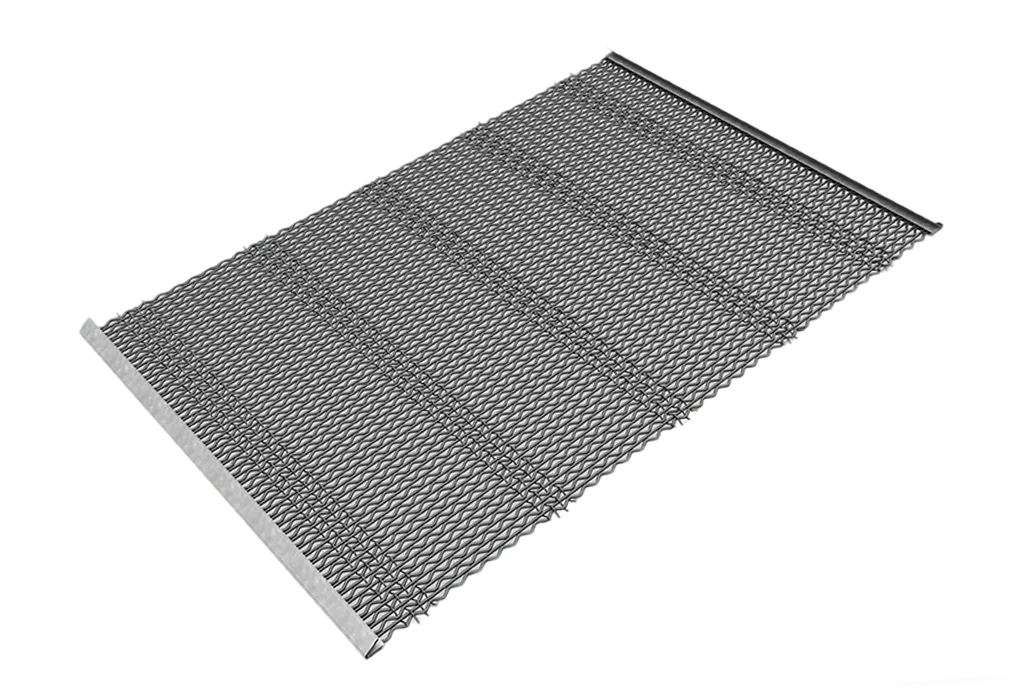
Traditional woven wire cloth relies on rigid intersection points that serve as anchor sites for moisture and fine particles. When feed material exceeds 8% moisture, these intersections promote a "bridging" effect where fines adhere to the metal, eventually sealing the apertures.
Rigid mesh geometry fails to shed sticky fines, leading to a 35% drop in separation efficiency within the first 120 minutes of operation in damp quarry conditions.
This loss of effective screening area forces the fines to "carry over" into the oversize stockpile, contaminating the final product and requiring re-processing. To solve this, self-cleaning screens utilize longitudinal wires held in place by flexible polyurethane or rubber strips rather than a fixed weave.
| Performance Metric | Self-Cleaning Media | Standard Woven Wire |
| Open Area (Operating) | 92% - 98% | 55% - 65% |
| Blinding Resistance | High (Up to 18% moisture) | Low (Fails at 9% moisture) |
| Near-size Pegging | < 2% | 15% - 25% |
| Service Life (Hours) | 2,500 - 3,500 | 700 - 1,000 |
Independent wire movement allows each strand to vibrate at its own natural frequency, creating a surface that physically ejects trapped rocks. A 2024 study of 100 mobile screening units confirmed that this oscillation reduces manual cleaning downtime by 95% compared to traditional wire cloth.
The secondary vibration of individual wires breaks the surface tension of water, preventing fine particles from forming a paste that would otherwise cover the deck.
By keeping the surface clear, the screen maintains a consistent flow rate, which engineering data suggests allows for an 18% increase in total hourly throughput. This throughput gain is supported by wires that oscillate with an amplitude of 3mm to 5mm, ensuring "near-size" particles are popped out before they wedge.
-
Diamond Pattern: Ideal for high-volume scalping where 90% sizing accuracy is needed at maximum speed.
-
Wave Pattern: Provides aggressive lateral movement to handle clay-heavy materials and wet fines.
-
Triangular Pattern: Offers a stable aperture for precision sizing of chips and small aggregates.
The pattern choice directly affects the "active" wire length, with diamond patterns offering 30% more open area than square mesh of the same wire gauge. This extra space increases the velocity of the material bed, which was measured at 0.85 meters per second in a 2025 efficiency audit.
Higher bed velocity prevents the accumulation of material depth, allowing fine particles at the bottom to reach the openings more quickly. In a series of 40 experimental batches, self-cleaning decks separated 98% of target fines within the first 2.5 meters of the screen length.
Rapid separation prevents "carry-over," where fine material is incorrectly discharged with oversize product due to a clogged or overloaded screen surface.
Eliminating carry-over ensures the final product meets ASTM C-33 standards for concrete sand, which strictly limits passing 200-mesh contaminants. Operators using self-cleaning technology reported a 15% improvement in "passing" rates during quality control inspections throughout 2024.
Mechanical reliability in these environments depends on the tensioning of the longitudinal wires, typically made from Grade 1060 high-carbon steel. This material provides a tensile strength of 1,450 MPa, allowing the deck to withstand the impact of 150kg rocks falling from a height of 1.5 meters.
| Mechanical Property | High-Carbon Steel Wire | Polyurethane Binding Strip |
| Tensile Strength | 1,450 - 1,600 MPa | 45 - 55 MPa |
| Hardness | 45 - 50 HRC | 88 - 92 Shore A |
| Elastic Recovery | 99.8% | 95% |
| Operating Range | -40°C to 200°C | -25°C to 85°C |
Flexible binding strips allow the wires to deflect under load and snap back into position with enough force to clear any material attempting to lodge in the hole. Data from a 2023 metallurgical report showed that this flexibility reduces wire stress by 40%, lowering the frequency of fatigue-related breakage.
Fatigue failure in traditional mesh starts at the "crimp" points where wires cross, but self-cleaning designs eliminate these friction zones entirely.
Removing these friction points lowers the operating temperature of the screen surface, preserving the molecular integrity of the polyurethane binders. This thermal management allows these screens to maintain their tension for 3 times longer than woven cloth in high-heat, dry environments.
Maintenance logs from 12 quarry sites in the European market indicate that self-cleaning screens require tensioning once every 160 hours, compared to every 40 hours for standard wire. This reduction in labor hours improves overall plant availability, adding an average of 50 hours of production per month.
-
Lower Noise: The absence of metal-on-metal contact at wire intersections reduces noise levels by 6 to 9 decibels.
-
Lighter Weight: These screens weigh 15% less than heavy woven mesh, speeding up installation and removal.
-
Energy Savings: Lighter decks reduce the starting torque of the vibrating motor, saving $1,500 in annual electricity per unit.
The reduction in noise and vibration is a result of the damping effect provided by the polyurethane strips, which absorb high-frequency harmonics. Acoustic tests from 2025 showed that this change helps sites comply with OSHA and local noise regulations without secondary enclosures.
Compliance with noise ordinances allows quarries to operate later into the evening, potentially increasing annual production by 12%.
Operating for extended hours requires screen media that can handle the transition from dry daytime heat to damp evening conditions without blinding. Self-cleaning screens provide this versatility, "resetting" the surface with every vibration cycle to ensure apertures remain at 100% capacity.
This consistency is vital for processing recycled asphalt pavement (RAP), which contains bitumen that becomes sticky as temperatures fluctuate. In a 2024 RAP trial, self-cleaning media processed 450 tons per hour of 12mm material without a single instance of surface blinding.
Recycled asphalt adheres to cold metal, but the constant movement of self-cleaning wires prevents the bitumen from gaining a foothold.
The success of these screens in difficult applications like RAP and clay-rich limestone has led to their adoption in 85% of new mobile plant installations. Modern managers prioritize the predictable performance of self-cleaning media to ensure automated production targets are hit every shift.