
ASIC Efficiency Joules per Terahash: The Only Spec That Compounds
Hashrate is a headline number; joules per terahash is the one that decides whether a machine makes money next year. A 500 TH/s rig at 20 J/TH draws 10 kW and consumes 240 kWh a day, which is $14.40 at $0.06/kWh against $18.24 of net daily earnings at today's difficulty of 132.76 T. At 30 J/TH, the same 500 TH/s draws 15 kW and pays $21.60 for the privilege of earning that same $18.24.

Key takeaways
- Efficiency multiplies every kilowatt-hour you buy into hashrate, and it is the only spec that changes the power side of the equation without touching the network.
- At 132.76 T a 100 TH/s unit earns $3.80/day gross and $3.65 net of the listed 4% PPS+ block-reward fee, so a 100 TH/s rig running at 30 J/TH burns $4.32/day in power at $0.06/kWh — more than it earns.
- The gap compounds at rack scale: a 1 PH/s rack draws 20 kW at 20 J/TH ($28.80 a day in power) and 30 kW at 30 J/TH ($43.20), a $14.40 daily difference — about $430 a month from efficiency alone.
- Efficiency is a maintenance metric, not a purchase spec — measure joules per terahash monthly, because dust, heat and failing hashboards move it without changing the nameplate.
Context in 2026
Bitcoin's difficulty adjustment ties block production to total network hashrate, so the reward pool is fixed and the competition for it grows. On 21 September 2026 the network was running at roughly 1,003 EH/s against a difficulty of 132.76 T, paying a 3.125 BTC subsidy plus transaction fees across 144 blocks a day — 450 BTC, about $38.1 million, shared by every miner on the network.
Two consequences follow for anyone holding hardware. First, your share of that pool shrinks as the network grows, unless you add machines. Second, the cost of producing your share does not shrink with it: a rig consumes what it consumes. That asymmetry is why miners who bought on hashrate per dollar and miners who bought on joules per terahash end up with very different results a year later.
It also explains why the payout choice matters less than it looks. PPS+ settles the block-reward component per share with a listed 4% fee and pays hourly against current difficulty; the transaction-fee component follows PPLNS logic at a listed 2%. Running PPLNS throughout combines both components at a listed 2% fee, distributed after six confirmations using a five-difficulty-round window. The fee spread between the two methods is worth single-digit percentages of income — while a 10 J/TH efficiency difference on a 500 TH/s rig is worth about $7 a day at $0.06/kWh.
The two variables that matter
Strip away the marketing and a mining rig has exactly two operating variables: how many hashes it computes per second, and how many joules it spends per hash. Everything else — pool, firmware, cooling design, overclocking — either moves those two numbers or fails to.
| Efficiency | Power draw | Daily consumption | Daily power cost | Net before pool fee |
|---|---|---|---|---|
| 18 J/TH | 1.8 kW | 43.2 kWh | $2.59 | +$1.21 |
| 20 J/TH | 2.0 kW | 48.0 kWh | $2.88 | +$0.92 |
| 25 J/TH | 2.5 kW | 60.0 kWh | $3.60 | +$0.20 |
| 30 J/TH | 3.0 kW | 72.0 kWh | $4.32 | −$0.52 |
The table is deliberately uncomfortable. At a $0.06/kWh tariff, a single 100 TH/s unit has $3.80 of gross earnings to work with, and the difference between a modern machine and a two-generation-old one is the difference between $1.21 and −$0.52 a day. Same hashrate, same coin, same pool. On a rack of ten units that spread is $17.30 a day in one direction or the other.
There is a second-order effect worth naming, because it is what makes efficiency compound rather than just add. Tighter process nodes and better thermal design raise efficiency, and higher efficiency at the same hashrate means lower cost per hash. Miners running lower cost per hash can keep hashing through price dips that force less efficient rigs offline — which is precisely how the network's hashrate and difficulty keep ratcheting upward. Efficiency is not only your margin; it is your survival threshold when the market cools.
Numbers from a real rig
Take a 100 TH/s machine measured at 20 J/TH and point it at a pool. Its share of a 1,003 EH/s network is 9.97 × 10⁻⁸. Multiply by the 450 BTC the network produces each day and it earns 0.00004486 BTC per day, which is $3.80 at $84,692 per BTC; after the listed 4% fee on the PPS-settled block-reward component it is $3.65.
Power is the other half of the same calculation. At 2 kW it consumes 48 kWh a day, or $2.88 at $0.06/kWh, leaving $0.77 a day net of both power and the listed pool fee. That is $23 a month per machine — thin enough that a hot room, a dirty intake or a failing hashboard erases it. A miner profitability ranking is the quickest sanity check on whether a given model still clears its electricity cost at current price and difficulty, and it is worth checking before you buy a batch rather than after.
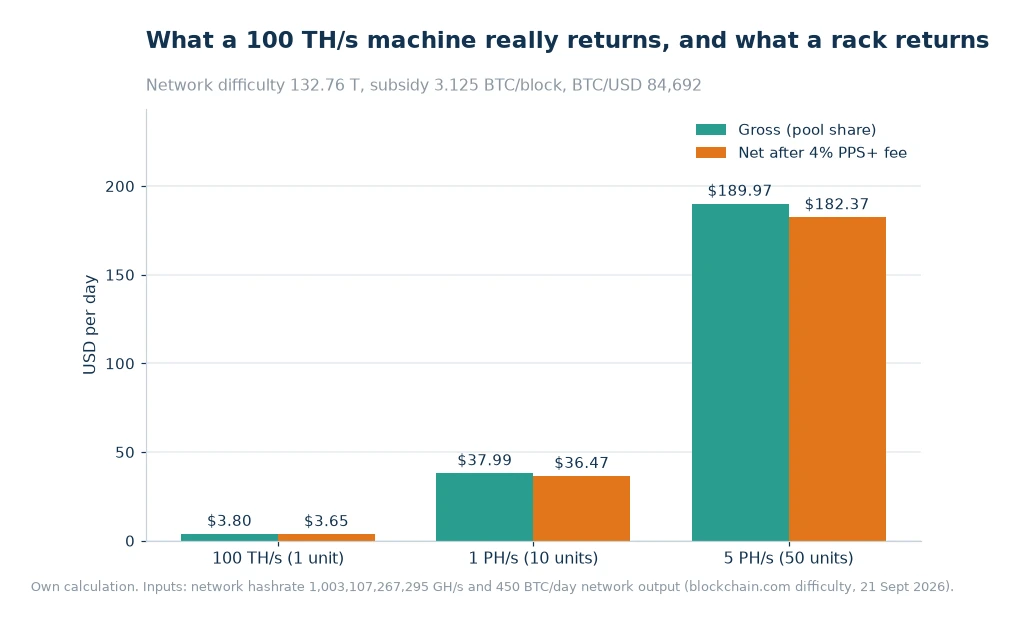
Scale it once and the efficiency argument stops being abstract. Ten units at 100 TH/s make a 1 PH/s rack earning $37.99 a day gross and $36.47 net of the listed fee. Fifty units make a 5 PH/s container earning $189.97 a day gross, $182.37 net. That container needs 50 kW at 20 J/TH — 1,200 kWh a day, $72 at $0.06/kWh — or 75 kW at 30 J/TH, which is 1,800 kWh and $108 a day. The efficiency difference is $36 a day, $1,080 a month, on one container, with no change in hashrate.
That is also where the payout rail starts to matter. A container earning $182 a day is a business with suppliers, and the pool account becomes the place its cash flow lives: balances, deposits, withdrawals and conversion sit in the same place as the mining stats, and mining payouts carry no fee. A multi-currency wallet attached to the mining account means a container's daily output does not have to be moved twice before it can pay a power bill.
Decision guide
When you are choosing machines or deciding whether to keep running one, four questions cover most of it.
- What is the measured J/TH, not the nameplate? Read it from the wall: total site power divided by pool-side valid hashrate. Both halves of that ratio are usually worse than the datasheet.
- Does the rig clear its own power bill at your tariff? At 132.76 T, 100 TH/s grosses $3.80 a day. Divide your daily power cost into that figure; anything near 1.0 means a difficulty increase ends the machine's life.
- What efficiency does the next machine buy? Five J/TH better on a 500 TH/s rig is worth roughly $3.60 a day at $0.06/kWh, which over a year is about $1,300 — before any resale value is considered.
- Can you switch coins without moving hardware? Efficiency only compounds if the machine keeps running. Multi-coin pools support switching between chains such as BTC, BCH, LTC/DOGE (merged mining), KAS, ZEC, HNS, CKB and ETC, which is the cheapest form of flexibility a rig can have. Accounts at an all-in-one ViaBTC Crypto Mining pool can be monitored per worker in real time through the web dashboard or the iOS and Android apps, so a rig that drifts off its efficiency profile shows up as a hashrate line rather than as a quarterly surprise.
Frequently asked questions
Do mining pools cost anything to join?
Joining is free; the pool earns from its fee on settled payouts, which appears as a percentage of the block-reward and transaction-fee components.
Can I mine more than one coin at the same time?
Yes. Merged mining lets a machine secure a parent chain and an auxiliary chain together, and multi-coin pools support switching between chains without moving hardware.
How much does one joule per terahash actually save?
On a 500 TH/s rig, one J/TH is about 0.5 kW, or 12 kWh a day — roughly $0.72 a day and $260 a year at $0.06/kWh. It scales linearly, so ten J/TH is about $7 a day.
Measure watts before you chase hashrate
Put a meter on the rig, read the pool-side hashrate for the same 24 hours, and write down the ratio. That single figure tells you whether the machine is paying for itself at today's difficulty and how much room you have if difficulty climbs. Then repeat it monthly, because efficiency decays quietly while difficulty does not. Optimising hashboards is worth doing — but measuring the watt side first is free.
Data and sources: network difficulty and hashrate from public chain data, ViaBTC pricing, payment methods and tooling[1][2]. Figures use 1,003,107,267,295 GH/s of network hashrate, 450 BTC mined per day, a $84,692 BTC price and $0.06/kWh, all read on 21 September 2026. Efficiency and tariff examples are illustrative; earnings move with difficulty and price.